Lilianna: My Story of Competing in the 2025 North American Youth Championship
However, humans don’t play like computer engines. The move apparently shocked my opponent and disrupted her normal plan of development, making it harder for her to find the right move.
BY Lilianna Gao
HER LEAGUE MEMBER & HER NEWS COLUMNIST
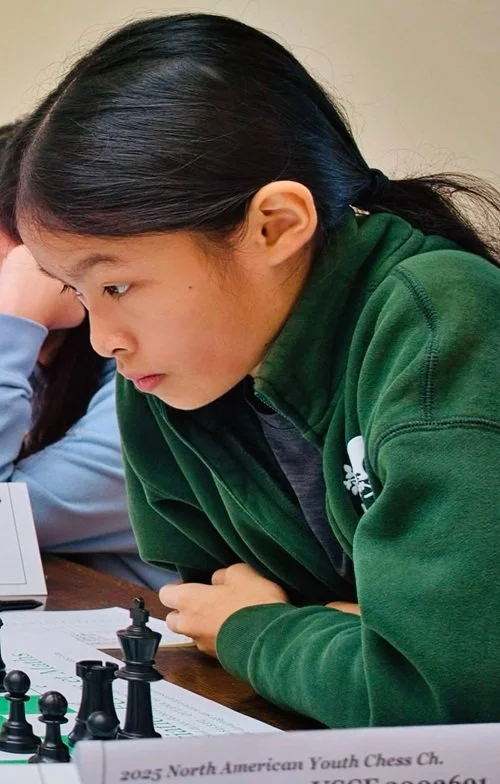
Photo courtesy of Lilianna Gao.
The 2025 North American Youth Chess Championship (NAYCC), held in Kingston, Canada, was quite memorable for me and my family.
We departed from our home to visit a family friend in Syracuse in the afternoon of Saturday, August 16th. We arrived just in time to enjoy a fulfilling meal: pork chops, tofu, noodles, and more Asian dishes. I personally think the Tong Sui (syrup water with lotus), a Cantonese delicacy, was the highlight. We went to Green Lakes State Park after dinner, and it was a refreshing hike through beautiful woodlands surrounding two glacial lakes.
On Sunday, after a nice brunch, we set off again and soon arrived at the hotel venue near Queen’s University, where the tournament was held. Interestingly, the area is known for having both active prisons and former prisons, many of which have been transformed into museums. I didn’t get to visit it, but if you’re ever in Kingston, check it out and let me know how it is!
The next morning, I attended the tournament’s opening ceremony and played my first-round game. My opponent, Freya Austin, was one of the top seeds in the tournament, and she went for a gambit line against me. I was able to gain an advantage from the opening by accepting the gambit and avoiding some tricks and traps. Knowing that the endgame would be hopeless for her; Freya sacrificed more material in the middlegame to complicate the position. It was a typical imbalance of material versus initiative, and both of us had to spend lots of time carefully navigating through the sharp and double-edged positions on the chessboard. When the dust settled, the position appeared drawn in a rook versus bishop endgame. Unfortunately for my opponent, she had burned too much time on the clock early on and made a mistake under time pressure near the very end. I felt sorry for Freya as she played a very good game and fought well, but I was very lucky to get my first win.
After winning my second round in a tactical battle against WCM Michelle Zhang, I was paired against another U.S. player, Ashley Lin. In the third round. I was able to obtain a better position in the King and Pawns endgame, as my three pawns stopped her four pawns on the queenside, and I could create a passed pawn on the kingside with my pawn majority. However, I made a serious mistake by advancing my e-pawn to e6 with the idea of getting a protected passer on the sixth rank, thinking that “the rest is a matter of technique.” Kudos to Ashley, as she found the right move to draw the game with a full-scale blockade! There was a similar position between two former U.S. Champions, Robert Byrne and John Grefe, in the 1975 U.S. Chess Championship held in Oberlin, Ohio. This is a very important motif in pawn endgames, especially when there are no other pieces on the board, and unfortunately, I missed this idea, throwing away the win!
On Wednesday, I won my games in both the fourth and fifth rounds against WCM Serena Yuan and Isabella Yan, respectively. I had 4.5 out of 5 and was leading the tournament halfway through. I was very happy about my performance and hoped I could continue the undefeated streak, but I got a cold shower in the sixth round. In the opening, my opponent, Audrey Zhou, surprised me with her early queen sorties. I was able to seize the initiative with rapid development while my opponent, with the white pieces, was lagging in development. Eventually, Audrey decided to castle queenside to get her king to safety, and I was able to win a pawn. This was the critical moment when I made a strategic mistake. I should have focused on stabilizing the position, avoiding counterplay, and converting the extra pawn by seeking the right exchange and creating a passed pawn. It’s generally good practice to play a solid and slow game when you have a material advantage. By keeping tension and waiting for your opponent to take risks, you give them more opportunities to go wrong. Instead, I got too carried away by my prior tournament results, and took a completely different approach - I sacrificed a piece for two pawns in a forcing line, and in the process, we liquidated most of our pieces. We were now in an endgame where I had a rook and five pawns against Audrey’s rook and two pawns, but she had an extra knight. My assets were the extra pawns, but in the endgame, when queens are off the board and there are very few pieces left, the king is such a good fighting piece against the pawns. This would be a draw with solid play, but I was unwilling to accept the outcome as my original intention was to go for a direct win by taking the risk in the middlegame transition. So, I decided to press for more, and unfortunately, this time I was the one who made a heartbreaking mistake in extreme time pressure with seconds on the clock. Congratulations to my opponent, who was able to defend solidly and patiently waited for me to make a mistake. She deserved the win! As for me, I learned a good lesson from this game! As John Maxwell said, “Sometimes you win, sometimes you learn!”
The next day, I drew both my games in the seventh and eighth rounds. My opponents played very well, and I had to accept two consecutive draws, worrying that I would be taking too much risk to push for a win. It is possible that the setback in round six had affected me negatively. Thanks to my family, who talked with me that evening and reminded me not to worry too much about the result, but instead to focus on the position and make the right decisions. This turned out to be a huge help to me in the final round.
On Saturday morning, I had the black pieces against my opponent, Kamatchi Muthu, in the final round. My opponent blitzed out the first few moves, and I thought it would not be too ideal for me if we continued to follow opening theory when I played with black, as my opponent would be playing for two results, with best play by both sides. I decided to deviate from the book and spiced up the game immediately, so I went for an early …g5! This was Judit Polgar’s signature aggressive move in the Sicilian Defense! She had used this pawn sacrifice to fight for control of the e5 square in her famous game against Alexey Shirov. In my case, however, it was more of a surprising weapon to force my opponent out of preparation and familiar territory. The move itself was not a very good one in the eyes of the computer engine, as I checked it after the game ended and I got back to the hotel room. Stockfish gave a clear advantage to my opponent after my move. However, humans don’t play like computer engines. The move apparently shocked my opponent and disrupted her normal plan of development, making it harder for her to find the right move. She started to burn a lot of time on the clock and eventually decided to keep her king in the center as well, which helped me justify my bold, attacking pawn thrust in the early opening. In the sharp and messy resulting position, when both our kings were stuck in the center, my opponent, despite playing very well, was impacted by time pressure. I was the lucky one to stand at the end of this exciting battle.
After winning my final round, I was very lucky to tie for first with WCM Serena Yuan, as we both scored 6.5/9, and eventually I won the gold medal on tiebreak due to our direct encounter in the fourth round! I attended the award ceremony and received a nice trophy cup and the direct WFM title based on my tournament performance. Every player I met in this tournament played very well, and I was just a bit luckier in the end.
I want to thank my family and coach, as without them, I would not have been able to do this! I also want to give a shout-out to the tournament organizers and all the arbiters and volunteers. They did a great job, and the tournament conditions and experience were very pleasant. Notably, the fair play procedures here were probably some of the best I have seen. Electronics were not allowed in the tournament area, and phones and smartwatches had to be turned in before the game. Parents were also not allowed to stay in the playing hall when the games were in progress. Re-entry to the tournament hall was not allowed for players except for washroom visits. There was no live game broadcast during the tournament, which prevented cheating to some extent. Multiple arbiters kept walking around inside the playing hall and watched carefully, and they occasionally checked entire rows of players at a time with a hand-held metal detector to ensure fair play. Subsequent to the final round of the tournament, all the winners had to undergo an additional fair play check before exiting the playing hall. After my final round, I was also requested for an additional fair play check before leaving. It was my first time having a fair play check after the game, but I understand why they want to do it, and I agree that these fair play measures are important.
Now that the chess part is covered, I’d like to talk about other experiences. We went to Queen’s University’s Geology Museum, which my sister and I really enjoyed. I was able to get sample rocks and gems and explore the museum’s widespread display. My family and I visited the shop before leaving, and I bought a soapstone dinosaur carving from Peru and a fossilized orthocone. Besides that, we also walked along the big rocks that formed a bridge-like structure over the ocean nearby. I even saw a furry animal, like a rodent, with a feral face, long body, and slim build, climbing under the rocks. It looked at me for a little while after I noticed it in the corner of my eye. I believe it was either a mink or an otter. It was hiding at first, then it came out a bit when it got curious. I’m leaning more towards a mink, based on the face and habits of the animal. This was a very interesting encounter! Additionally, I was able to go swimming with my sister in the hotel pool once and take cool pictures underwater with my phone!
After the tournament ended, we headed towards Toronto to visit our extended family. After about three hours’ drive, we arrived just in time for dinner. Soon after, I worked a little on the summer homework I hadn’t finished yet, which included enrichment packets, reading, an essay, and more.
The next day, we toured the campus of the University of Toronto (U of T). We walked through the campus and park area with my extended family. We did more touring and came across an interesting painting called The Fall of Water (2006–07), which is supposedly inspired by Pieter Bruegel’s 1562 The Fall of the Rebel Angels. The painting I saw was accredited to the Hart House Permanent Collection, Carole Condé and Karl Beveridge, digital print. After that, we headed to Chinatown for lunch. We had delicious mango pudding, hot buns, fried milk, and more. After lunch, we browsed the amazing sights and little shops there, and I got a bamboo hat that I really like!
And that’s my story of my summer trip to the 2025 North American Youth Championship in Kingston, Canada. I hope you enjoyed reading about it as much as I enjoyed writing it!
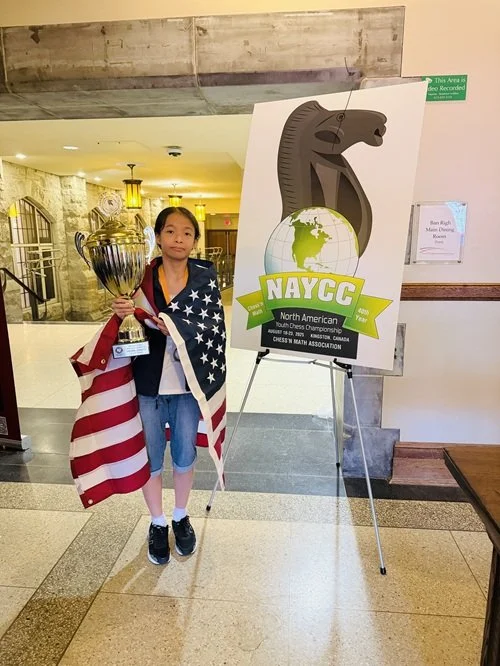
Photo courtesy of Lilianna Gao.